Hypoxylon Canker and OaksHypoxylon Cankerhas been noted in the death of many oaks in the East Nashville area over the last several years. This disease is not rare, but due to the stressful droughts of the last several summers, a large number of trees are being affected. The following is a description of hypoxylon canker in oak, taken from the Plant Disease Handbook: |
|
||||||||
| “Hypoxylon Canker (fungus – Hypoxylon atropunctatum and otherHypoxylonspp.): The disease is first evident as a dieback of one ormore branches. The foliage of the diseased limbs turns yellow and
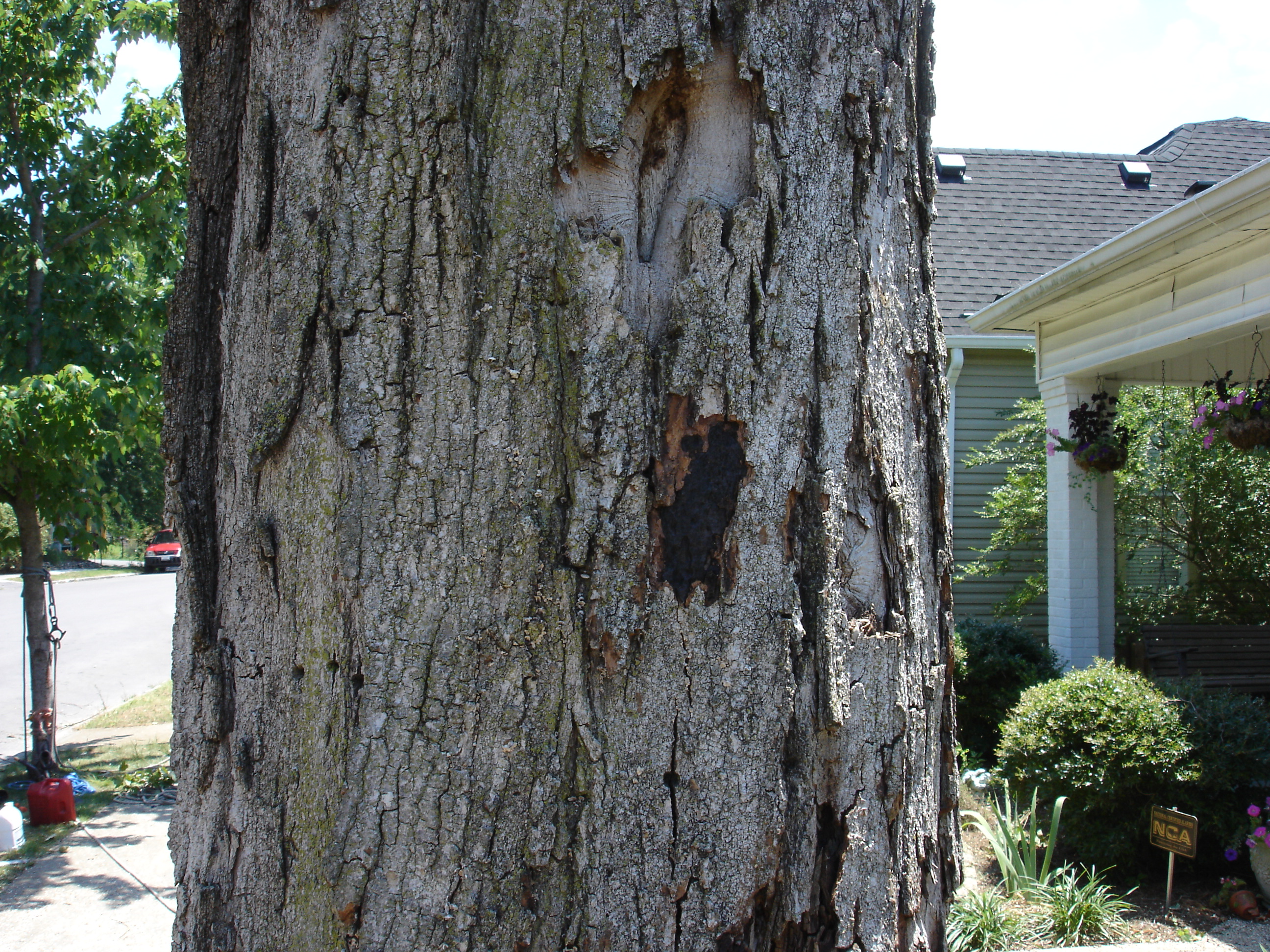
dries. This dieback continues from branch to branch through the stem until eventually the tree dies. This may require 1 or more years depending upon the environment and amount of stress experienced by the tree. Near death or shortly after tree death the outer bark sloughs off and exposes large masses of brown, dusty one-celled spores (conidia). These spores are gone within a few weeks and a grayish surface is visible. This is covered with numerous black fruiting structures. Mature fruiting structures (perithecia) can forcibly discharge sexual spores (ascospores) for distances of 60 mm. They are then blown to surrounding trees where infection occurs again. Entry appears to be through injured surfaces on limbs or trunk. The fungus grows best at 86 degrees F but can grow at 50 and 100 degrees F.Hypoxylon canker causes a dark brown discoloration of the sapwood. With age the infected wood is lighter in color and has black zones or patterns in the wood when observed in cross section.Hypoxylon canker occurs primarily on trees which are or have been in stressed conditions. Trees which have been damaged by excessive fill soil are often attacked by this organism. It is also suspected to be a fungus that can invade on oak wilt-infected trees. Control is achieved by maintaining the trees in a healthy condition. Avoid injury to the trunk and limbs and never apply fill soil around the trees. Chemical treatments would not be effective because the fungus is located within the tree.” |
|||||||||
| Here is a pdf file with helpful facts about Hypoxolonhttp://www.forestry.state.ar.us/manage/hypoxylon.pdf | |||||||||
| Here are a few links to other descriptive siteshttp://www.sfrc.ufl.edu/4h/hypocank.htm | |||||||||
|
|||||||
 Ethical Arborists
Leave a comment
Comments feed for this article